Pineal Gland Hormones and their Psychiatric Relevance: Melatonin and Serotonin

Über den Vortrag
Der Vortrag „Pineal Gland Hormones and their Psychiatric Relevance: Melatonin and Serotonin“ von Melissa Kalensky, FNP-BC, PMHNP-BC, CNE ist Bestandteil des Kurses „Hormonal and Genetic Influences in Psychopharmacology“.
Quiz zum Vortrag
Where is the pineal gland located, and what is its primary hormonal contribution to systemic circulation?
- It is a pinecone-shaped structure deep in the brain above the thalamus that primarily releases melatonin into the systemic circulation.
- It is a pea-sized structure in the pituitary fossa that primarily releases serotonin into the systemic circulation.
- It is a leaf-shaped structure in the frontal cortex that primarily releases dopamine into the systemic circulation.
- It is a cone-shaped structure in the cerebellum that primarily releases norepinephrine into the systemic circulation.
- It is a spherical structure in the basal ganglia that primarily releases cortisol into the systemic circulation.
Why are sleep disturbances common in many patients after a traumatic brain injury (TBI)?
- Injury to the pineal gland can reduce melatonin production and disrupt circadian rhythm regulation.
- Injury to the pituitary gland can reduce cortisol production and eliminate sleep-wake cycles.
- Injury to the hypothalamus can increase adenosine production and cause chronic insomnia.
- Injury to the frontal lobe can increase dopamine production and prevent normal sleep onset.
- Injury to the cerebellum can decrease GABA production and suppress melatonin receptors.
Which statement best explains why both medications and dietary changes are used to regulate serotonin in psychiatric practice?
- Medications target brain serotonin as a neurotransmitter, while diet helps regulate serotonin produced in the GI tract acting as a hormone.
- Medications increase serotonin absorption from food sources, while diet directly raises serotonin levels in the cerebrospinal fluid.
- Medications control serotonin production in the gut lining, while diet selectively increases serotonin within the raphe nuclei.
- Medications convert gut serotonin into brain melatonin, while diet prevents serotonin from crossing the blood-brain barrier.
- Medications block serotonin receptors in brain tissue, while diet depletes peripheral serotonin stores to enhance mood.
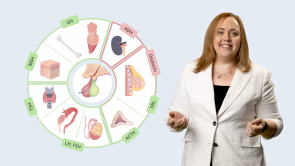
Dozent des Vortrages Pineal Gland Hormones and their Psychiatric Relevance: Melatonin and Serotonin

Melissa Kalensky, FNP-BC, PMHNP-BC, CNE
Dr. Melissa Kalensky, FNP-BC, PMHNP-BC, CNE is dual-certified as a Family Nurse Practitioner and a Psychiatric Mental Health Nurse Practitioner.
She specializes in primary care, community health, and integrated behavioral healthcare. Her expertise spans trauma-informed care and psychiatry across all age groups, from children to adults.
At Lecturio, she teaches psychopharmacology to advanced practice providers, helping to bridge the gap between psychiatric and primary care practice.
Kundenrezensionen
5,0 von 5 Sternen
| 5 Sterne |
|
5 |
| 4 Sterne |
|
0 |
| 3 Sterne |
|
0 |
| 2 Sterne |
|
0 |
| 1 Stern |
|
0 |


