Peripheral Hormones and their Psychiatric Relevance: Cortisol and Insulin

Über den Vortrag
Der Vortrag „Peripheral Hormones and their Psychiatric Relevance: Cortisol and Insulin“ von Melissa Kalensky, FNP-BC, PMHNP-BC, CNE ist Bestandteil des Kurses „Hormonal and Genetic Influences in Psychopharmacology“.
Quiz zum Vortrag
Which of the following best describes a key concern related to elevated cortisol levels in psychopharmacology?
- They can manifest as increased anxiety or depression by weakening the hippocampus over time.
- They primarily cause acute psychosis by directly increasing dopamine synthesis in the striatum.
- They mainly lead to cognitive impairment through disruption of prefrontal cortex functioning.
- They frequently trigger manic episodes by excessively stimulating reward pathways in the brain.
- They commonly induce obsessive-compulsive symptoms through serotonergic pathway dysregulation.
In clinical practice, why is it important to monitor insulin levels in patients taking many atypical antipsychotics?
- Because these psychotropic drugs directly influence insulin action, requiring monitoring to prevent serious metabolic complications.
- Because these medications frequently induce rapid hypoglycemia through excessive pancreatic beta-cell stimulation.
- Because atypical antipsychotics commonly trigger autoimmune destruction of insulin-producing pancreatic cells.
- Because these drugs routinely cause acute ketoacidosis by blocking hepatic glucose production pathways.
- Because antipsychotics typically induce severe hyperthyroidism that secondarily disrupts glucose metabolism.
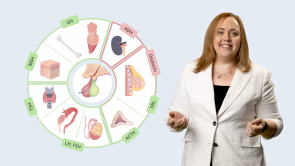
Dozent des Vortrages Peripheral Hormones and their Psychiatric Relevance: Cortisol and Insulin

Melissa Kalensky, FNP-BC, PMHNP-BC, CNE
Dr. Melissa Kalensky, FNP-BC, PMHNP-BC, CNE is dual-certified as a Family Nurse Practitioner and a Psychiatric Mental Health Nurse Practitioner.
She specializes in primary care, community health, and integrated behavioral healthcare. Her expertise spans trauma-informed care and psychiatry across all age groups, from children to adults.
At Lecturio, she teaches psychopharmacology to advanced practice providers, helping to bridge the gap between psychiatric and primary care practice.
Kundenrezensionen
5,0 von 5 Sternen
| 5 Sterne |
|
5 |
| 4 Sterne |
|
0 |
| 3 Sterne |
|
0 |
| 2 Sterne |
|
0 |
| 1 Stern |
|
0 |


