Sex Hormones and their Psychiatric Relevance: Estrogen, Testosterone and Progesterone

About the Lecture
The lecture Sex Hormones and their Psychiatric Relevance: Estrogen, Testosterone and Progesterone by Melissa Kalensky, FNP-BC, PMHNP-BC, CNE is from the course Hormonal and Genetic Influences in Psychopharmacology.
Included Quiz Questions
Estrogen modulates several neurotransmitters that influence mood and cognition. Which set of neurotransmitters is specifically affected by estrogen?
- Serotonin, dopamine, glutamate, and GABA
- Serotonin, norepinephrine, acetylcholine, and GABA
- Dopamine, norepinephrine, histamine, and glutamate
- Acetylcholine, histamine, glycine, and GABA
- Glutamate, glycine, norepinephrine, and serotonin
Which statement best differentiates how low testosterone commonly presents in men versus women?
- Men often report fatigue, irritability, depression, and poor concentration, whereas women often report fatigue, low libido, depression, and difficulty concentrating.
- Men often report cognitive improvement and increased energy, whereas women often report sedation and hypersomnia.
- Men often report panic attacks and obsessive thoughts, whereas women often report compulsive behaviors and paranoia.
- Men often report insomnia, weight gain, and psychosis, whereas women often report agitation, mania, and hallucinations.
- Men often report euphoria and hypersexuality, whereas women often report apathy and social withdrawal.
When using estrogen-containing hormone replacement therapy (HRT) for mood and cognitive symptoms in menopause, what timing principle is emphasized?
- Initiating HRT at the very beginning of menopause may offer the greatest emotional and cognitive benefits.
- Delaying HRT until at least 10 years after menopause maximizes cognitive benefits.
- Starting HRT only after multiple antidepressant trials have failed improves mood outcomes.
- Beginning HRT in late adolescence prevents menopausal mood changes entirely.
- Using short intermittent HRT courses late in menopause is superior to early continuous therapy.
What role of progesterone helps explain its impact on anxiety?
- Progesterone acts as a GABA modulator, enhancing the primary inhibitory neurotransmitter that reduces neuronal excitability.
- Progesterone directly blocks serotonin reuptake, increasing synaptic serotonin and excitability.
- Progesterone primarily stimulates glutamate receptors, increasing excitatory signaling in the brain.
- Progesterone inhibits dopamine synthesis, reducing reward pathway activation and vigilance.
- Progesterone functions as a norepinephrine agonist, increasing arousal and sympathetic tone.
A 52-year-old woman presents with new-onset depressed mood, irritability, anxiety, and brain fog, and has had no menses for 12 consecutive months. What is the most appropriate initial psychiatric approach?
- Consider whether her symptoms are secondary to menopause and evaluate the appropriateness of hormone supplementation before starting SSRIs.
- Immediately diagnose major depressive disorder and begin high-dose SSRI without endocrine evaluation.
- Order serial hormone levels to confirm menopause, as lab values are required for the diagnosis.
- Treat presumptively with stimulants for adult-onset ADHD before addressing hormonal factors.
- Defer all treatment until spontaneous resolution, as menopausal mood symptoms are always self-limited.

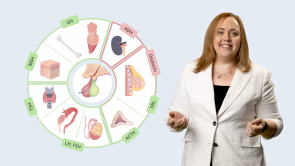
Author of lecture Sex Hormones and their Psychiatric Relevance: Estrogen, Testosterone and Progesterone

Melissa Kalensky, FNP-BC, PMHNP-BC, CNE
Customer reviews
5,0 of 5 stars
| 5 Stars |
|
5 |
| 4 Stars |
|
0 |
| 3 Stars |
|
0 |
| 2 Stars |
|
0 |
| 1 Star |
|
0 |


