Hormonal Influences in Psychopharmacology: Endocrine Pathways

About the Lecture
The lecture Hormonal Influences in Psychopharmacology: Endocrine Pathways by Melissa Kalensky, FNP-BC, PMHNP-BC, CNE is from the course Psychopharmacology (APRN).
Included Quiz Questions
Which statement best describes how hormones typically act in the body compared with neurotransmitters?
- Hormones generally produce gradual changes over days to weeks and broadcast widely like TV signals.
- Hormones typically cause immediate changes within seconds and act only at a single synapse.
- Hormones move only within the brain and never affect organs outside the central nervous system.
- Hormones always function identically to traditional neurotransmitters at neuronal synapses.
- Hormones act in a purely one-way fashion and do not participate in feedback regulation.
When a patient presents with new-onset psychosis, what should the mental health provider do?
- Broaden the differential diagnosis to include medical causes and consider a full medical workup.
- Start long-acting antipsychotics immediately without further diagnostic evaluation.
- Assume psychosis is almost always due to one of a few psychiatric disorders.
- Delay any medical assessment until several psychotropic medication trials have failed.
- Rely solely on textbook diagnostic criteria without considering endocrine conditions.
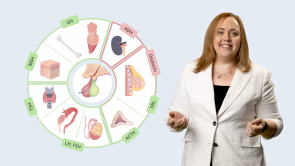
Which three hormone pathways are highlighted as primary for psychiatric practice?
- Hypothalamic-pituitary-adrenal axis, hypothalamic-pituitary-thyroid axis, and sex hormone pathways.
- Renin-angiotensin-aldosterone system, insulin-glucagon axis, and growth hormone pathways.
- Hypothalamic-pituitary-gonadal axis, pancreatic beta-cell axis, and prolactin pathways.
- Sympathetic-adrenal-medullary axis, melatonin-pineal axis, and parathyroid pathways.
- Insulin signaling pathway, leptin-adipose pathway, and vitamin D-calcium axis.
Author of lecture Hormonal Influences in Psychopharmacology: Endocrine Pathways

Melissa Kalensky, FNP-BC, PMHNP-BC, CNE
Customer reviews
5,0 of 5 stars
| 5 Stars |
|
5 |
| 4 Stars |
|
0 |
| 3 Stars |
|
0 |
| 2 Stars |
|
0 |
| 1 Star |
|
0 |
Quiz Overview
wrong
right
open

