Pineal Gland Hormones and their Psychiatric Relevance: Melatonin and Serotonin

About the Lecture
The lecture Pineal Gland Hormones and their Psychiatric Relevance: Melatonin and Serotonin by Melissa Kalensky, FNP-BC, PMHNP-BC, CNE is from the course Hormonal and Genetic Influences in Psychopharmacology.
Included Quiz Questions
Where is the pineal gland located, and what is its primary hormonal contribution to systemic circulation?
- It is a pinecone-shaped structure deep in the brain above the thalamus that primarily releases melatonin into the systemic circulation.
- It is a pea-sized structure in the pituitary fossa that primarily releases serotonin into the systemic circulation.
- It is a leaf-shaped structure in the frontal cortex that primarily releases dopamine into the systemic circulation.
- It is a cone-shaped structure in the cerebellum that primarily releases norepinephrine into the systemic circulation.
- It is a spherical structure in the basal ganglia that primarily releases cortisol into the systemic circulation.
Why are sleep disturbances common in many patients after a traumatic brain injury (TBI)?
- Injury to the pineal gland can reduce melatonin production and disrupt circadian rhythm regulation.
- Injury to the pituitary gland can reduce cortisol production and eliminate sleep-wake cycles.
- Injury to the hypothalamus can increase adenosine production and cause chronic insomnia.
- Injury to the frontal lobe can increase dopamine production and prevent normal sleep onset.
- Injury to the cerebellum can decrease GABA production and suppress melatonin receptors.
Which statement best explains why both medications and dietary changes are used to regulate serotonin in psychiatric practice?
- Medications target brain serotonin as a neurotransmitter, while diet helps regulate serotonin produced in the GI tract acting as a hormone.
- Medications increase serotonin absorption from food sources, while diet directly raises serotonin levels in the cerebrospinal fluid.
- Medications control serotonin production in the gut lining, while diet selectively increases serotonin within the raphe nuclei.
- Medications convert gut serotonin into brain melatonin, while diet prevents serotonin from crossing the blood-brain barrier.
- Medications block serotonin receptors in brain tissue, while diet depletes peripheral serotonin stores to enhance mood.
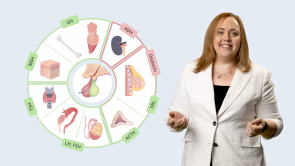
Author of lecture Pineal Gland Hormones and their Psychiatric Relevance: Melatonin and Serotonin

Melissa Kalensky, FNP-BC, PMHNP-BC, CNE
Customer reviews
5,0 of 5 stars
| 5 Stars |
|
5 |
| 4 Stars |
|
0 |
| 3 Stars |
|
0 |
| 2 Stars |
|
0 |
| 1 Star |
|
0 |


