Hypothalamic-Pituitary-Thyroid Axis: Hormonal Regulation and Psychiatric Implications

About the Lecture
The lecture Hypothalamic-Pituitary-Thyroid Axis: Hormonal Regulation and Psychiatric Implications by Melissa Kalensky, FNP-BC, PMHNP-BC, CNE is from the course Hormonal and Genetic Influences in Psychopharmacology.
Included Quiz Questions
Which statement best describes how the hypothalamic-pituitary-thyroid axis maintains stable thyroid hormone levels?
- Rising T3 and T4 inhibit TRH and TSH release through a negative feedback loop.
- Rising T3 and T4 stimulate more TRH and TSH release through a positive feedback loop.
- TSH levels rise when T3 and T4 are high to increase thyroid hormone production further.
- TRH directly stimulates the thyroid gland to produce T3 and T4 without TSH involvement.
- TSH produced by the hypothalamus inhibits TRH and stabilizes T3 and T4 levels accordingly.
Which description accurately differentiates T3 from T4 in terms of biological function?
- T3 is more biologically active, while T4 serves mainly as a stable reservoir converted to T3.
- T3 is the main circulating hormone, while T4 is only produced in peripheral tissues for conversion.
- T3 has a longer half-life than T4, making T3 the primary long-term hormone reservoir in the body.
- T3 is produced only in the liver and kidneys, while T4 is produced only in brain tissue areas.
- T3 is primarily protein-bound and inactive, while T4 circulates unbound and is fully active always.

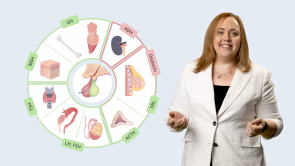
Author of lecture Hypothalamic-Pituitary-Thyroid Axis: Hormonal Regulation and Psychiatric Implications

Melissa Kalensky, FNP-BC, PMHNP-BC, CNE
Customer reviews
5,0 of 5 stars
| 5 Stars |
|
5 |
| 4 Stars |
|
0 |
| 3 Stars |
|
0 |
| 2 Stars |
|
0 |
| 1 Star |
|
0 |


